
 by
In enterprise software delivery, there is an unspoken open secret that everyone knows but few admit: nobody actually reads the 80-page Business Requirements Document (BRD) before signing off on it.
Executives skim the executive summary, business sponsors flip directly to the signature page, and engineers glance at the diagrams while wondering how much of the prose will actually survive contact with reality. Yet, organizations routinely spend 8 to 12 weeks drafting, redlining, and debating these static documents under the illusion that document sign-off equates to risk reduction.
In our foundational articles on Structured Intent Engineering and Autonomous Agent Execution, we laid out how AI-driven pipelines compress requirements gathering and scaffolding. In this article, we tackle the governance counterpart: Demo-Driven Validation.
1. The Document Approval Mirage
Document-driven approvals fail because human cognition cannot effectively simulate complex software systems from static prose. This creates three predictable enterprise failure modes:
- The Ambiguity Vacuum: When a document states “The dashboard will display real-time transaction anomalies”, the business sponsor imagines an instant live telemetry stream, while the developer plans a daily batch cron job that runs at midnight. Both sign the document believing they are in total agreement.
- Ceremonial Rubber-Stamping: When approval is required to unlock budget, executives approve documents they haven’t thoroughly vetted simply to prevent project paralysis.
- The Month-6 Reality Shock: When the system is finally revealed in User Acceptance Testing (UAT) after six months of development, stakeholders realize the user experience doesn’t match their operational workflow. The result is acrimonious change requests, blown budgets, and missed deadlines.
2. The AIDRAD Alternative: Day-3 Interactive Validation
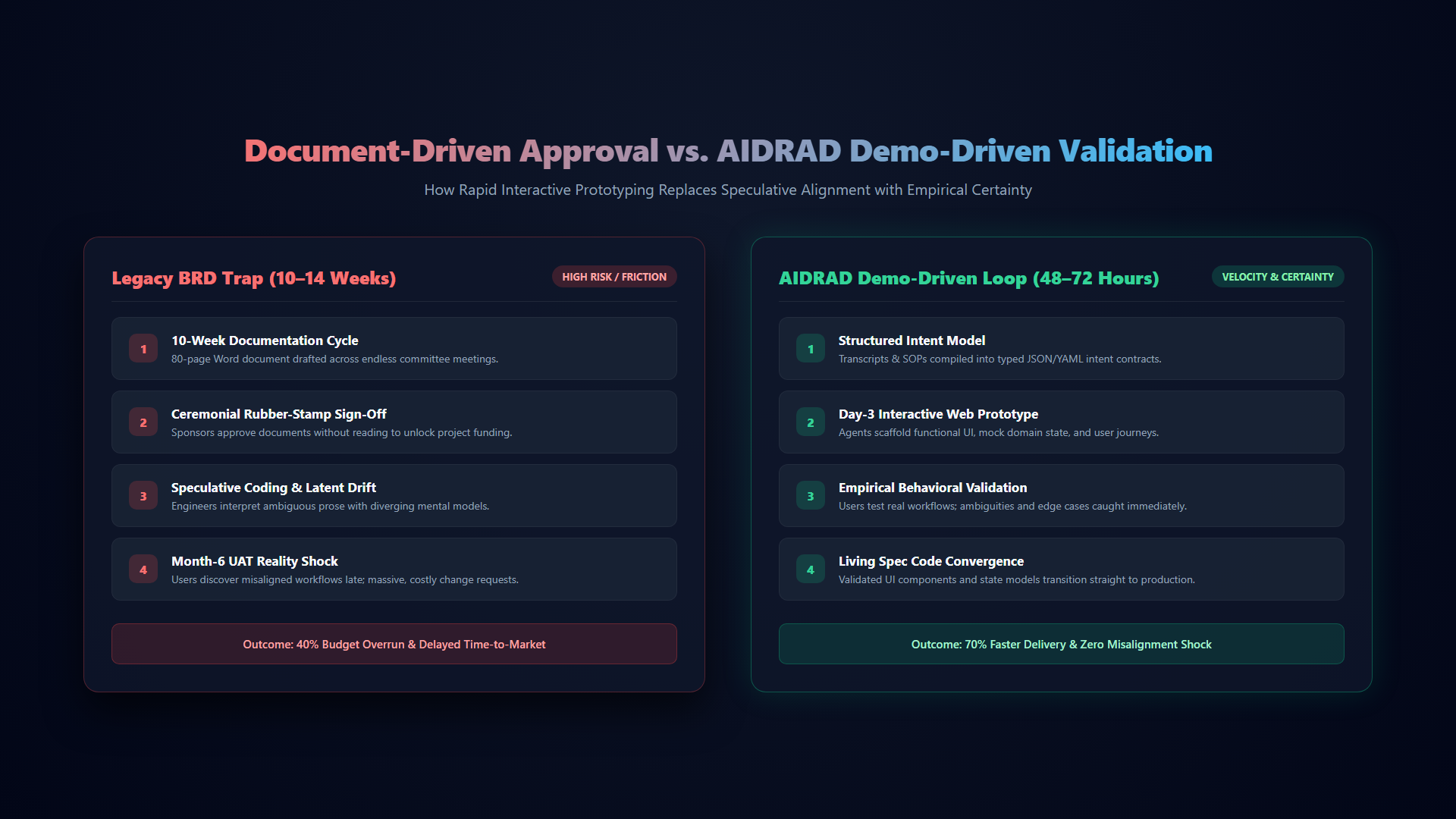
flowchart LR
    A["📐 Structured Intent Model
Typed Contracts"] --> B["⚡ Day-3 Interactive Prototype
Live Working UI"]
    B --> C["👥 Tactile Human Validation
Clickable Workflows"]
    C --> D["🎯 Instant Edge Case Discovery
Zero Speculative Drift"]
    D --> E["🚀 Living Spec Convergence
Production Hardening"]

    style A fill:#1e293b,stroke:#3b82f6,stroke-width:2px,color:#f8fafc
    style B fill:#1e293b,stroke:#a855f7,stroke-width:2px,color:#f8fafc
    style C fill:#1e293b,stroke:#38bdf8,stroke-width:2px,color:#f8fafc
    style D fill:#1e293b,stroke:#f59e0b,stroke-width:2px,color:#f8fafc
    style E fill:#064e3b,stroke:#34d399,stroke-width:2px,color:#f8fafc
📋 Click to view / copy raw Mermaid source
flowchart LR
    A["Structured Intent Model (Typed Contracts)"] --> B["Day-3 Interactive Prototype (Live Working UI)"]
    B --> C["Tactile Human Validation (Clickable Workflows)"]
    C --> D["Instant Edge Case Discovery (Zero Speculative Drift)"]
    D --> E["Living Spec Convergence (Production Hardening)"]
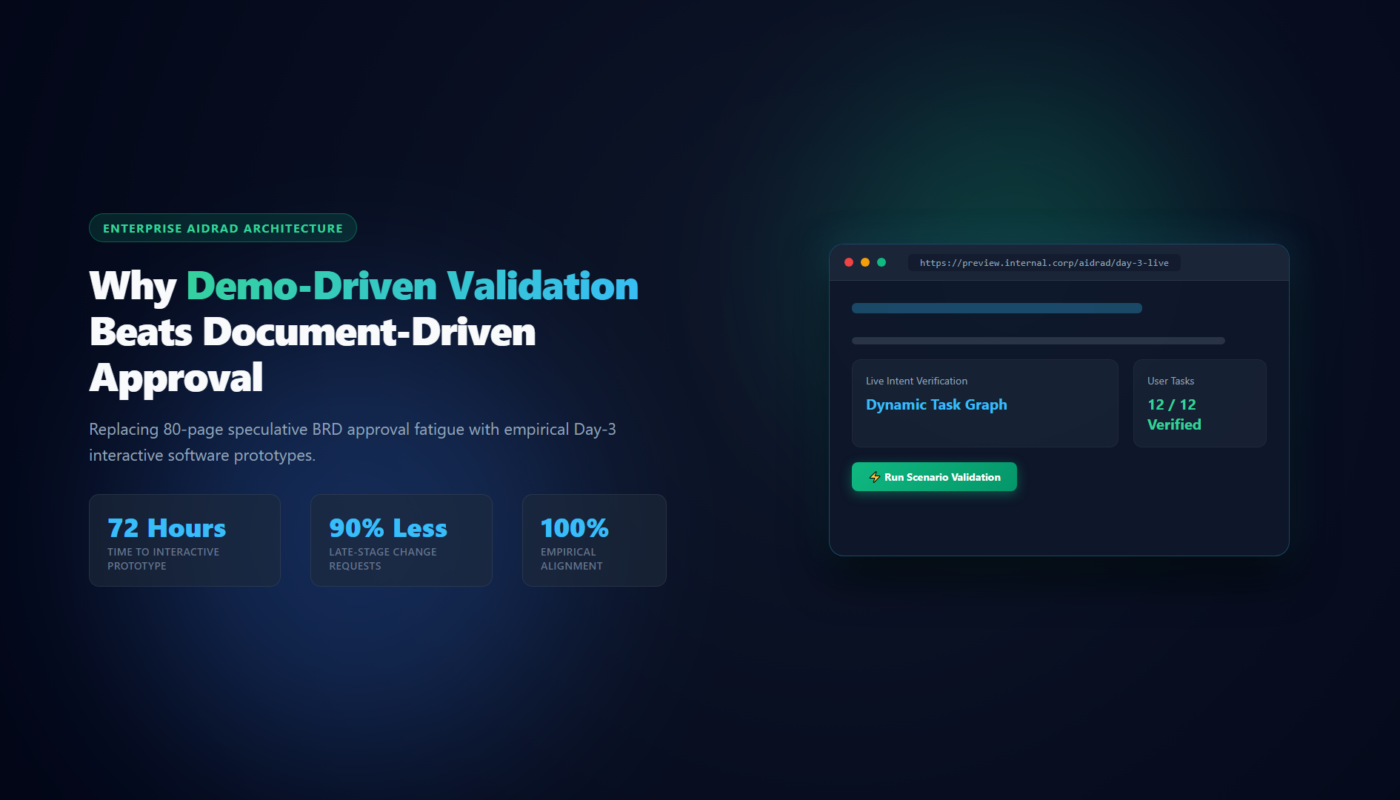
Rather than asking stakeholders to approve an abstract textual description of software, AIDRAD (AI-Driven Rapid Application Delivery) mandates generating an interactive, clickable software prototype within 72 hours of initial intent capture.
When stakeholders sit in front of a live, functioning interface—even one backed by mock data and synthetic APIs—their evaluation mode changes instantly from speculative abstraction to tactile reality:
- Immediate Edge Case Discovery: Within two minutes of clicking around a live prototype, a claims officer will notice: “Wait, where do I input a retroactive claim that occurred in a previous tax year?” That question would never have surfaced during a slide deck walkthrough.
- Empirical Workflow Validation: Instead of debating whether a 3-step wizard or a modal form is better in a committee meeting, users test both in 5 minutes and declare the winner based on task completion speed.
- Zero Interpretation Loss: The interactive demo itself becomes the living specification. The frontend components, state models, and validation logic demonstrated in Day 3 form the baseline for production hardening.
3. Comparison: Document Trap vs. Demo-Driven Velocity
| Dimension | Legacy Document-Driven Approval | AIDRAD Demo-Driven Validation |
|---|---|---|
| Artifact Under Review | 60–100 page Word document / PDF | Interactive, containerized web prototype (Day 3) |
| Stakeholder Feedback | Theoretical semantic debates on wording | Empirical task completion & behavioral feedback |
| Time to First Validation | 8 to 14 weeks | 48 to 72 hours |
| Cost of Pivoting | Catastrophic (rewriting code post-UAT) | Trivial (updating prompt & re-scaffolding in minutes) |
| Alignment Certainty | Low (assumed consensus until delivery) | High (verified through direct interaction) |
4. How AI Makes Day-3 Prototypes Viable
Historically, building high-fidelity interactive prototypes in 72 hours was impossible because frontend scaffolding, CSS styling, and mock state management required weeks of developer effort. Prototypes were either ugly low-fidelity wireframes that failed to evoke real user reactions or threw away code.
With modern LLM code generators and component design systems (Tailwind CSS, shadcn/ui, Next.js), an autonomous agent can transform a structured intent schema into a responsive, fully themed enterprise dashboard in under 30 minutes. The scaffolding includes:
- Realistic synthetic domain data generated via Faker/LLMs rather than generic “Lorem Ipsum”.
- Functional client-side validation rules that mirror actual enterprise business constraints.
- Realistic latency and loading states to demonstrate real-world asynchronous feedback.
Executive Takeaways
- Replace Signatures with Interaction: Never accept a signature on a document as proof of alignment. Insist on stakeholders interacting with a working prototype.
- Compress Feedback Loops to 72 Hours: The sooner users touch the interface, the faster false assumptions are disproven before expensive backend engineering begins.
- Prototype as the Living Spec: Code that is demonstrated to stakeholders is 10x more unambiguous than English prose written by committee.