
 by
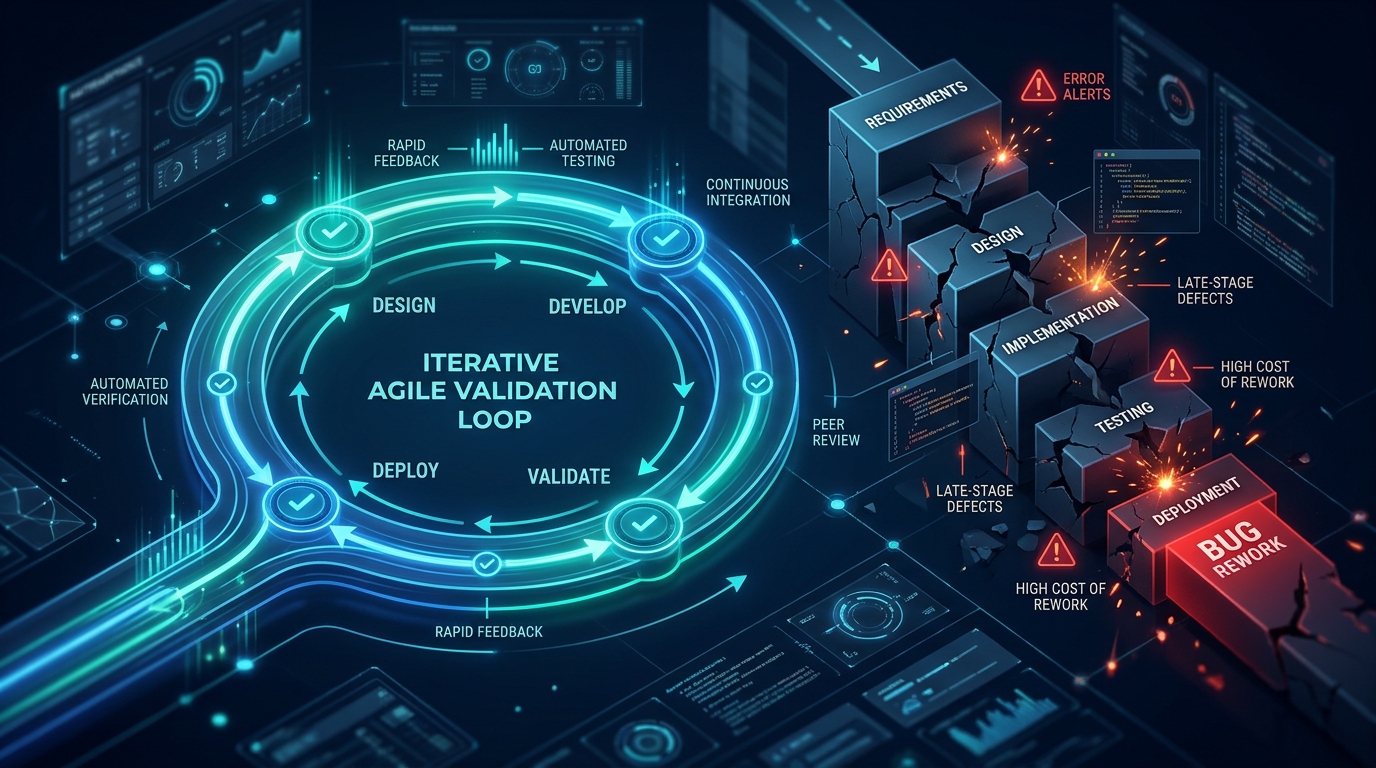
In traditional enterprise software engineering, the single most destructive cost driver is not developer hourly rates or infrastructure licensing. It is late-stage rework.
Every technology executive is intimately familiar with the pattern: an internal tooling project is approved in Q1, requirements are gathered across six weeks of committees, development runs for three months, and during User Acceptance Testing (UAT) in week 14, an operational director offhandedly remarks: “Wait, this assumes inventory numbers are updated synchronously? Our legacy warehouse system only syncs at midnight via batch SFTP. This architecture won’t work.”
Immediately, the project hits an architectural iceberg. Backend models must be rewritten, message queues retrofitted, database transactions converted to eventual consistency, and the go-live delayed by three months. The cost to fix that structural misunderstanding in production is 50 times higher than fixing it on day two.
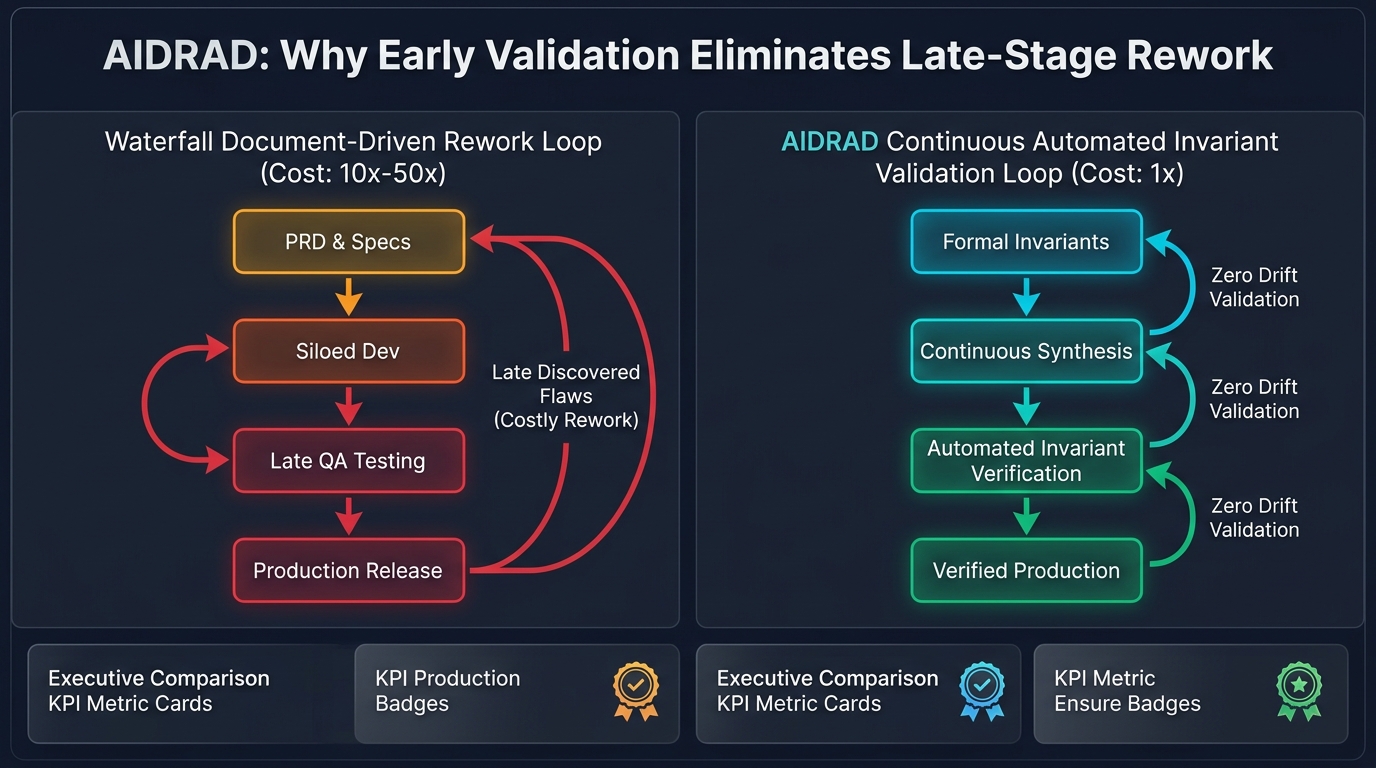
In our foundational essay on why internal applications should not take months anymore and our recent blueprint on the Intent to Demo to Harden to Go-Live lifecycle, we argued that delivery speed without early rigor is just fast failure. In the AIDRAD (AI-Driven Rapid App Delivery) framework, we eliminate late-stage rework by enforcing Continuous Automated Early Validation.
1. The 50x Cost of Change Curve
Barry Boehm’s classic software engineering cost curve remains as true today in the age of generative AI as it was thirty years ago: a flaw caught in the requirements phase costs 1x to resolve. That same flaw caught in architecture costs 5x. In staging, it costs 15x. Once released to production with live customer data, it costs 50x to 100x in emergency patches, schema migrations, and CAB escalations.
flowchart LR
    A["📐 Intent & Schema Contract
Pydantic Invariant Spec"] --> B["🧪 Synthetic Stress Testing
Boundary & Mutation Checks"]
    B --> C["⚡ 72-Hour Live Interactive Demo
Direct Stakeholder Feedback"]
    C -->|Pass| D["🔒 Hardened Production Core
Zero Late-Stage Churn"]
    C -->|Fail| A

    style A fill:#1e293b,stroke:#38bdf8,stroke-width:2px,color:#f8fafc
    style B fill:#1e293b,stroke:#a855f7,stroke-width:2px,color:#f8fafc
    style C fill:#1e293b,stroke:#f59e0b,stroke-width:2px,color:#f8fafc
    style D fill:#064e3b,stroke:#34d399,stroke-width:2px,color:#f8fafc
📋 Click to view / copy raw Mermaid source
flowchart LR
    A["Intent & Schema Contract (Pydantic Invariant Spec)"] --> B["Synthetic Stress Testing (Boundary & Mutation Checks)"]
    B --> C["72-Hour Live Interactive Demo (Direct Stakeholder Feedback)"]
    C -->|Pass| D["Hardened Production Core (Zero Late-Stage Churn)"]
    C -->|Fail| A
Modern AI agents can write code in seconds. However, if an agent is pointed at ambiguous or unvalidated requirements, it simply generates technical debt at unprecedented speed. True delivery acceleration requires shifting the quality gate from post-commit testing to pre-code intent synthesis.
2. Why Traditional “Shift-Left” Testing Fails
Enterprises often believe they have solved early validation by implementing unit testing and linting pipelines. This is an illusion:
- Unit tests only verify developer assumptions: A unit test verifies whether the code matches the developer’s understanding of the requirement. If the developer misunderstood the business rule, the unit test will pass with 100% green coverage while the application remains fundamentally broken.
- Mocks mask integration realities: Mocking external ERP or CRM systems creates synthetic serenity. The real system has quirks, rate limits, timezone offsets, and data anomalies that mocks silently ignore.
- Documents cannot be executed: Requirements trapped in Word documents or Jira stories cannot be programmatically validated against data models before coding begins.
3. The 3-Tier AIDRAD Early Validation Gate
AIDRAD replaces passive document reviews with a rigorous three-tier programmatic validation gate executed within the first 72 hours of any internal application build:
- Declarative Invariant Contracts: Before frontend components or API routers are built, business logic is codified as declarative Pydantic schemas enforcing mathematical and role-based boundaries.
- Synthetic Edge-Case Stress Testing: Generative agents flood the invariant schema with thousands of boundary mutations (e.g., negative amounts, future timestamps, duplicate identifiers, circular approval chains) to expose logical contradictions immediately.
- The 72-Hour Live Interactive Demo Gate: Within three days of project kickoff, stakeholders interact with a functioning vertical prototype running against real data structures. Misconceptions are surfaced while code is still malleable.
4. Working Code: Declarative Invariant Contract Harness
Below is a production-grade Python harness utilizing Pydantic to enforce business invariants before application services are committed. Notice how business rules are declared as immutable assertions rather than buried inside database stored procedures:
# Enterprise Schema & Invariant Contract Validator
from pydantic import BaseModel, Field, model_validator
from datetime import date
from typing import Optional

class DisbursementContract(BaseModel):
    claim_id: str = Field(..., regex=r"^CLM-[0-9]{6}$")
    amount_usd: float = Field(..., gt=0.0, description="Amount must be positive")
    submitter_id: str
    approver_id: str
    approval_date: date
    disbursement_date: Optional[date] = None

    @model_validator(mode="after")
    def verify_invariants(self):
        # Invariant 1: Approver cannot be submitter
        if self.submitter_id == self.approver_id:
            raise ValueError("Invariant Violation: Submitter and Approver cannot be identical.")

        # Invariant 2: Disbursement cannot precede approval
        if self.disbursement_date and self.disbursement_date < self.approval_date:
            raise ValueError("Invariant Violation: Disbursement date cannot precede approval date.")

        # Invariant 3: High value threshold validation
        if self.amount_usd > 10000 and not self.approver_id.startswith("EXEC-"):
            raise ValueError("Invariant Violation: Claims exceeding $10k require Executive approval.")

        return self
When automated test runners execute against this contract, violations fail instantly with explicit explanatory traces, preventing ambiguous states from contaminating database tables.
5. Gotchas & Governance
Implementing continuous early validation requires strict organizational guardrails:
- Resist “Mock-Only” Validation: Never declare an early demo validated if it only operates on happy-path synthetic data. Inject real anonymized schemas and historical data anomalies early, just as we demonstrated in our guide on deterministic document reassembly.
- Enforce Invariant Immutability: Invariant contracts must reside in version-controlled repositories. Changing a core business invariant requires a formal pull request review, not a casual database column alteration.
- Timebox the Demo Gate: Early validation is an accelerator, not an invitation to resume endless requirement meetings. The interactive demo must force a binary decision: approve intent or iterate within 24 hours.
Executive Takeaways
- Eliminate Late-Stage Friction: Catching architectural and business intent mismatches in the first 72 hours reduces overall delivery cost by up to 50x compared to production retrofits.
- Executable Contracts Over Narrative Specs: Replacing ambiguous prose with programmatic invariant schemas guarantees that developers, AI agents, and business stakeholders share an identical source of truth.
- Predictable Enterprise Velocity: When requirements are validated through functioning prototypes rather than passive slide decks, UAT shrinks from weeks of debate to hours of verification.