


 by
In enterprise engineering teams adopting Large Language Models, a strange phenomenon has taken hold: prompt engineering theater.
Junior engineers and consultants proudly present 4,000-word “mega-prompts” packed with conversational pleasantries (“You are a helpful and polite assistant who always thinks step-by-step…”), repetitive warnings, and conflicting narrative rules. When the model occasionally hallucinates or drops a schema rule, the team’s knee-jerk reaction is to make the prompt even longer: adding another three paragraphs demanding that the AI “really make sure not to forget”.
This approach runs counter to the fundamental architecture of transformer models. Long, undisciplined prompts degrade accuracy, inflate operational token costs, introduce unpredictable latency, and create fragile applications.
In our architecture guide on why AI-driven delivery is an operating model, not a tool choice and our analysis of compressing the SDLC with AI, we demonstrated that speed stems from structure. In AIDRAD, we practice Prompt Discipline: minimizing token weight while maximizing invariant enforcement.
1. The Physics of Attention Decay
Language models do not read text like humans; they attend across token matrices using self-attention heads. The academic literature has thoroughly documented the “Lost-in-the-Middle” effect: instructions placed in the middle of long prompts experience significant attention degradation compared to tokens located at the extreme beginning (primacy) or the termination boundary (recency).
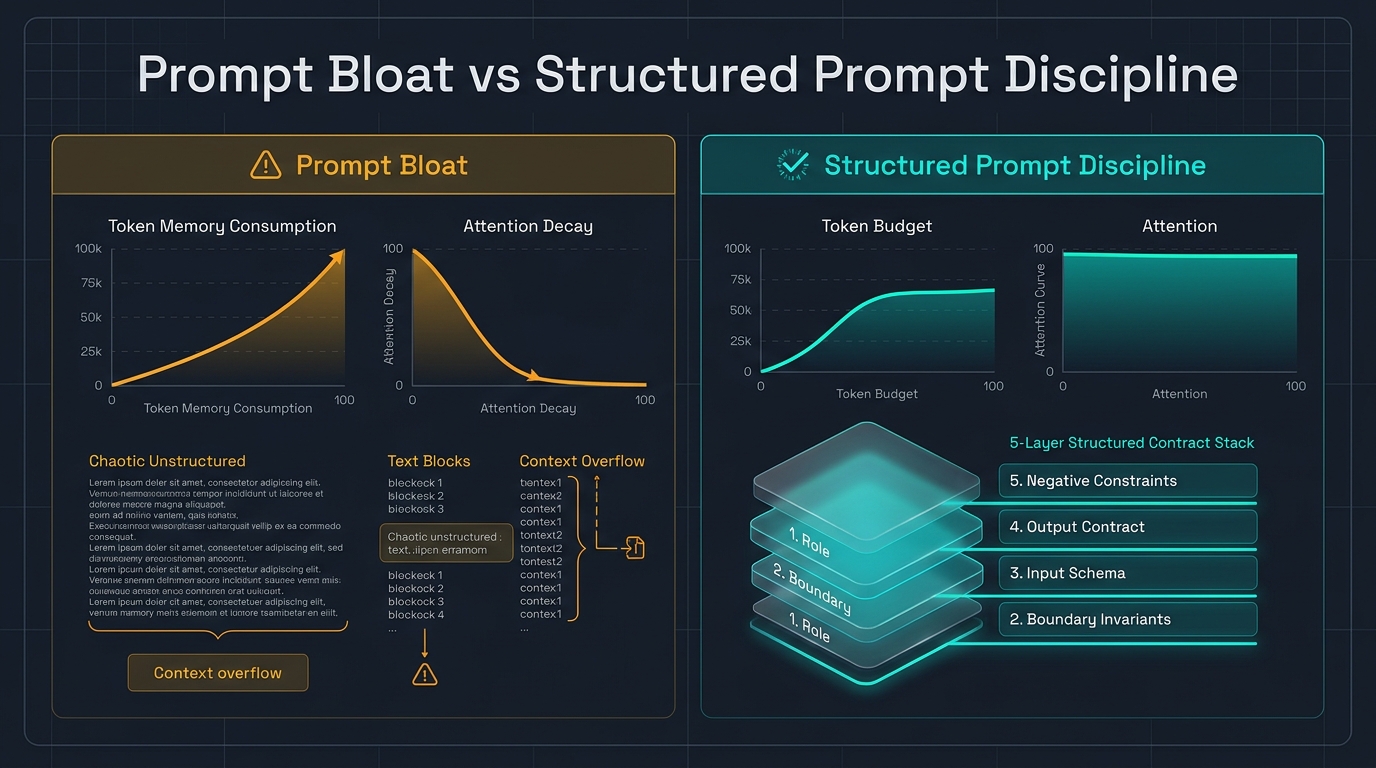
flowchart TD
    subgraph Bloat ["❌ Prompt Bloat Anti-Pattern"]
        B1["4,000-Word Essay Prompt
Polite Filler & Unstructured Rules"] --> B2["Attention Decay & Hallucination
Lost-in-the-Middle Decay"]
        B2 --> B3["Unpredictable Non-Deterministic Output
High Cost & Latency Spikes"]
    end

    subgraph Discipline ["✅ AIDRAD Structured Prompt Contract"]
        D1["5-Layer Structured Contract
Role + Invariants + Schema + Output"] --> D2["Constant Attention Retention
Predictable Low-Token Execution"]
        D2 --> D3["Deterministic Machine-Verified Output
Sub-Second API Reliability"]
    end

    style Bloat fill:#2d1515,stroke:#ef4444,stroke-width:2px,color:#f8fafc
    style Discipline fill:#0f291e,stroke:#34d399,stroke-width:2px,color:#f8fafc
📋 Click to view / copy raw Mermaid source
flowchart TD
    subgraph Bloat ["Prompt Bloat Anti-Pattern"]
        B1["4,000-Word Essay Prompt (Polite Filler & Unstructured Rules)"] --> B2["Attention Decay & Hallucination (Lost-in-the-Middle Decay)"]
        B2 --> B3["Unpredictable Non-Deterministic Output (High Cost & Latency Spikes)"]
    end

    subgraph Discipline ["AIDRAD Structured Prompt Contract"]
        D1["5-Layer Structured Contract (Role + Invariants + Schema + Output)"] --> D2["Constant Attention Retention (Predictable Low-Token Execution)"]
        D2 --> D3["Deterministic Machine-Verified Output (Sub-Second API Reliability)"]
    end
When you bury a critical business boundary inside a 3,000-word prompt, you are mathematically increasing the probability that the model’s attention heads will overlook it during autoregressive generation. Prompt discipline is not about brevity for its own sake—it is about keeping attention density concentrated on core invariants.
2. The 5-Layer Disciplined Prompt Architecture
Every enterprise prompt in the AIDRAD pipeline conforms to a rigid 5-layer declarative schema:
- Execution Role (1 Line): Declares the exact operational capability (e.g.,
[ROLE]: Deterministic Security Classifier). Strips all biographical fluff. - Immutable Invariants (The “Never” Rules): Hard boundaries that must never be broken (e.g.,
submitter_id != approver_id;zero external API calls). - Input Schema Normalization: Pure structured data (JSON, YAML, or delimited markdown) without conversational framing.
- Output Contract Specification: Explicit JSON Schema or Gutenberg HTML schema defining keys, datatypes, and nullability.
- Termination Negative Assertions: Positioned at the very end of the prompt to leverage recency bias (e.g.,
OUTPUT MUST BE PURE JSON. ZERO PREAMBLE. ZERO MARKDOWN FENCES.).
3. Working Comparison: Bloat vs. Discipline
Examine the operational contrast below. The conversational prompt consumes 450 tokens, drifts across runs, and occasionally adds apologies. The disciplined contract consumes 72 tokens and executes deterministically across hundreds of API requests:
# Comparison: Bloated Prompt vs. Disciplined Contract

# 1. THE BLOATED PROMPT (Anti-Pattern: ~450 tokens, high ambiguity)
BLOATED_PROMPT = \"\"\"
Hello Assistant! You are an expert enterprise backend architect. Please look at the
user request very carefully. We want to build an invoice approval API. It is very
important that users cannot approve their own invoices because of compliance. Also,
make sure that if the invoice is over $50,000, it goes to the VP. If there are any
errors, please provide a nice friendly error message. Be concise, professional, and
format your output in JSON so our frontend can read it easily. Thank you very much!
\"\"\"

# 2. THE AIDRAD DISCIPLINED PROMPT CONTRACT (Pattern: 72 tokens, zero ambiguity)
DISCIPLINED_CONTRACT = \"\"\"
[ROLE]: Financial Invariant Parser
[CONSTRAINTS]:
- Strict JSON output matching InvoiceDecision schema only.
- ZERO conversational filler, markdown fences, or preamble.
- INVARIANT_1: submitter_id != approver_id
- INVARIANT_2: amount_usd > 50000 => requires_vp = true
[SCHEMA]:
{"invoice_id": str, "valid": bool, "requires_vp": bool, "violations": list[str]}
[INPUT]: {payload}
\"\"\"
By slashing token overhead by 80%, you simultaneously cut inference latency by 3x and reduce cloud billing by thousands of dollars at enterprise scale, as we explored in our guide to self-hosted enterprise automation.
4. Governance, Versioning, and Automated Linting
Prompt discipline must be enforced programmatically within your CI/CD pipeline:
- Prompts as Versioned Code: Prompts must never live as ad-hoc strings in application code. Store them in a dedicated
/promptsdirectory managed under Git with semantic versioning tags. - Automated Token Budgets: Establish a CI linting gate that fails any prompt whose system instruction exceeds 300 tokens without an architectural exception approved by the Lead Architect.
- Regression Assertion Suites: Test prompt modifications against a gold-standard benchmark suite of 100 historical edge cases. If accuracy drops on a single invariant, the pull request cannot merge.
Executive Takeaways
- Attention Density Over Length: Bloated prompts trigger the “Lost-in-the-Middle” attention decay, leading to hallucinated outputs and missed validation rules.
- 80% Operational Cost Reduction: Replacing conversational narratives with 5-layer structured contracts slashes token consumption and eliminates latency spikes.
- Deterministic Enterprise Reliability: Treating prompts as versioned, linted code assets ensures predictable software behavior across model upgrades.