

 by
by Most discussions about AI-driven delivery start with tools. Which assistant should we use? Which model is better? Which code generator is faster? Which platform has the best interface?
Those questions matter, but they are not the core issue. A tool can accelerate an individual task. An operating model makes that acceleration repeatable, governable, and useful across many internal applications.
That distinction is at the center of AIDRAD, the AI-Driven Rapid App Delivery framework. AIDRAD is not a claim that one tool can replace delivery discipline. It is a way to organize intent, prototyping, hardening, go-live, and learning so that AI helps the delivery system instead of becoming another disconnected experiment.
Why tool-first thinking fails
A tool-first approach usually creates a short burst of excitement. Someone builds a demo quickly. A workflow looks possible. A screen appears faster than expected. But then the hard questions arrive:
- Who owns the requirement?
- What changed after the demo feedback?
- Where does the data persist?
- What access model is required?
- How will the application be deployed and supported?
- Which patterns should be reused next time?
If those questions are not part of the model from the beginning, AI only moves the bottleneck. It may speed up the first visible output while leaving production readiness just as unclear as before.
What an operating model adds
An operating model defines how work moves from idea to outcome. It tells the team what inputs matter, what stages exist, what quality gates apply, what can be automated, what must be reviewed, and what should be captured for reuse.
In AIDRAD, AI is used across the flow, but it is not treated as the owner of the flow. The model keeps human accountability in the right places:
- Intent structuring: AI helps synthesize business inputs, but stakeholders validate the intent.
- Demo generation: AI accelerates the working prototype, but users validate the workflow.
- Engineering hardening: AI assists implementation, but standards, security, data design, and integration choices remain governed.
- Go-live readiness: deployment, access, support, and operational checks are planned instead of improvised.
- Reuse: learnings become patterns, templates, prompts, and checklists for the next delivery.
Tool-agnostic by design
Tools are ingredients, not the recipe
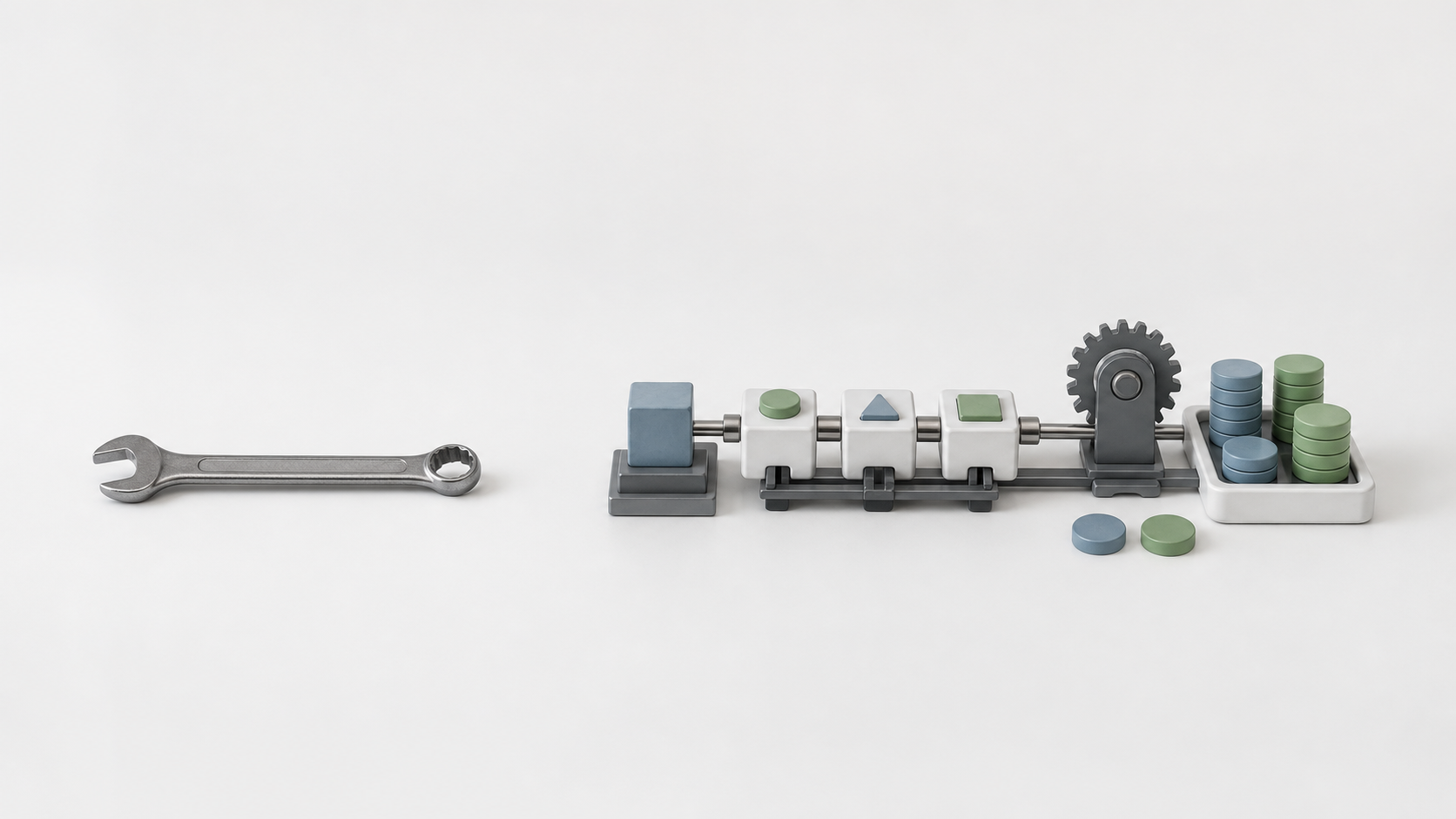
A useful way to think about AIDRAD is that each tool owns a job, but none of them owns the whole delivery system. Copilot can help extract and structure requirements. Google AI App Studio or similar app-builder tools can help create a quick prototype. Codex can help implement and harden the code. Docker can make deployment repeatable. Power Automate Desktop can automate specific operational steps.
The operating model decides when each tool is used, what output it must produce, who reviews that output, and when the work is ready to move to the next stage.
A strong AI delivery model should not depend on one assistant, one model, or one vendor staying ahead forever. Tools will change. Capabilities will improve. Pricing, policies, and enterprise controls will evolve.
That is why AIDRAD is tool-agnostic. The framework is about the sequence of work and the discipline around it. Any useful tool must fit into that sequence. If a better tool appears tomorrow, the model should absorb it without rewriting the whole delivery philosophy.
The real management question
For leaders, the question should not be, “Are our teams using AI?” A better question is, “Are we using AI inside a repeatable delivery system that improves speed, quality, governance, and learning?”
The difference is significant. Random AI usage creates isolated productivity gains. A structured operating model creates compounding gains. Every delivery can improve the next one because patterns are captured instead of lost.
What good looks like
Good AI-driven delivery should feel faster without feeling loose. Stakeholders should see working outcomes earlier. Delivery teams should spend less time translating vague inputs. Governance teams should have clearer checkpoints, not fewer checkpoints. Operations should receive applications that are easier to deploy, support, and evolve.
That is the reason AIDRAD begins with operating discipline. The value is not in saying AI was used. The value is in building a delivery system where AI helps internal applications move from intent to production with less ambiguity, less rework, and more trust.
Related reading
- Previous in AIDRAD: why internal applications should not take months anymore
- Generate meeting minutes and action items with Copilot
- Turn email and Teams follow-ups into Todoist tasks
- Locally hosting a Google AI App Studio app with Docker