
 by
Every week, enterprise software teams burn hundreds of engineering hours in alignment meetings. In our previous articles on Replacing BRD Fatigue with Structured Intent Engineering and Ingesting Meeting Transcripts and SOPs, we demonstrated how unstructured stakeholder dialogue can be converted into strict, machine-readable intent contracts.
Yet in 95% of organizations, this is where the momentum dies. Teams install Microsoft Copilot or Zoom AI Companion, celebrate that they received a 5-bullet summary in their inbox, and then spend the next three weeks manually transcribing those bullets into Jira tickets, architectural diagrams, and boilerplate boilerplate code.
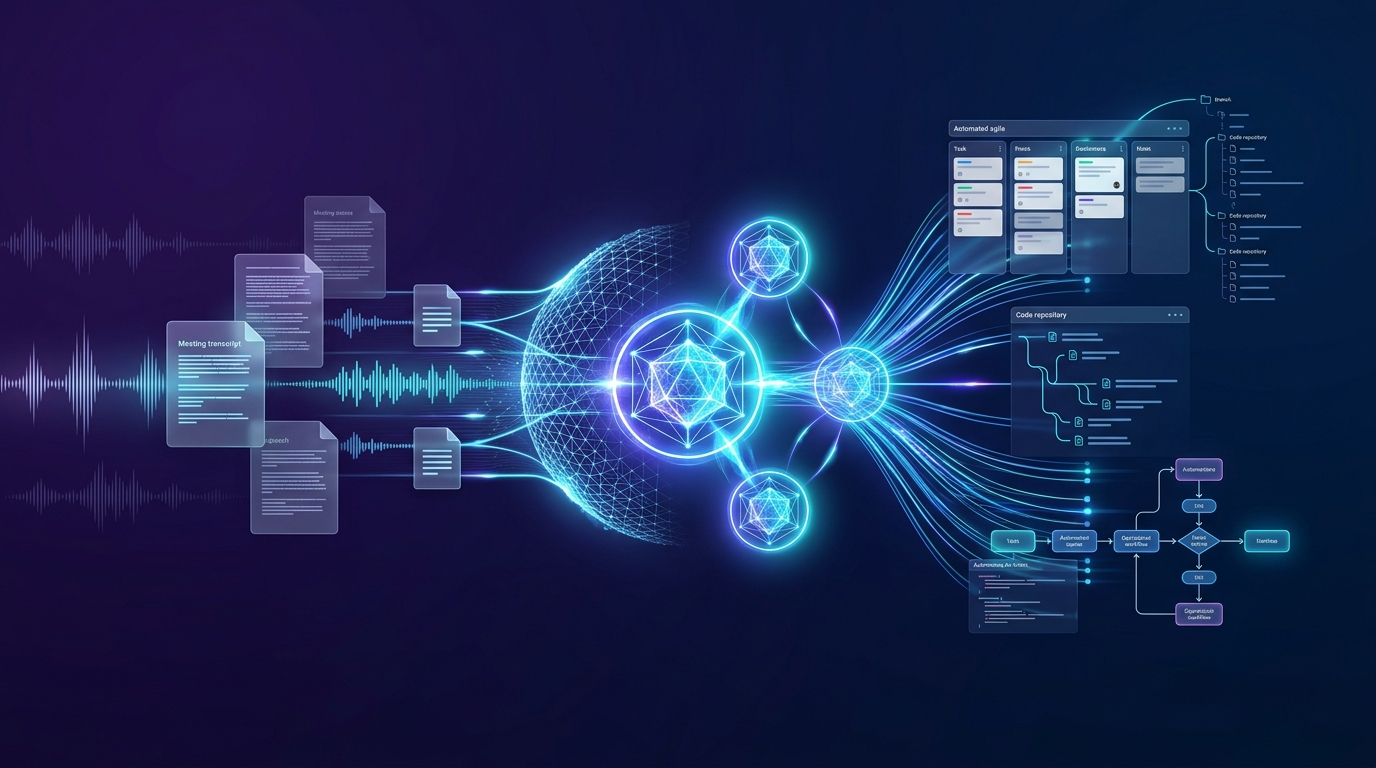
In the AIDRAD (AI-Driven Rapid Application Delivery) paradigm, meeting notes are not passive records. They are executable execution triggers. This article breaks down how to architect an autonomous agent pipeline that takes raw meeting transcripts and automatically builds, tests, and stages working implementation artifacts within hours.
1. The Chasm: Why Static Summaries Fail Engineering
Standard LLM meeting summaries suffer from three fatal flaws:
- Loss of Technical Specificity: A product manager says, “We must ensure transaction IDs use UUIDv7 so they remain time-sortable in Postgres.” The generic summary reduces this to: “Team discussed database identifiers.”
- Lack of Dependency Mapping: Discussions jump erratically between API schemas, UI design, and compliance rules. Bulleted lists cannot represent the strict topological order required to build a feature.
- Zero Accountability for Execution: A bullet saying “Alex will look into Redis caching” does not spin up a test branch, configure connection strings, or benchmark cache hit ratios.
2. Architecture: The Transcript-to-Execution Pipeline
flowchart LR
    A["📝 Meeting Transcripts"] --> B["⚙️ Action Extraction Engine"]
    B --> C["🕸️ Directed Acyclic Graph (DAG)
Dependency Mapping"]
    C --> D["🤖 Specialized Agent Workers
Schema • API • QA Test"]
    D --> E["🧪 Test Verification Harness
Deterministic Pytest / Ruff"]
    E --> F["🚀 Production PR & Live Staging"]

    style A fill:#1e293b,stroke:#3b82f6,stroke-width:2px,color:#f8fafc
    style B fill:#1e293b,stroke:#a855f7,stroke-width:2px,color:#f8fafc
    style C fill:#1e293b,stroke:#38bdf8,stroke-width:2px,color:#f8fafc
    style D fill:#1e293b,stroke:#f59e0b,stroke-width:2px,color:#f8fafc
    style E fill:#1e293b,stroke:#10b981,stroke-width:2px,color:#f8fafc
    style F fill:#064e3b,stroke:#34d399,stroke-width:2px,color:#f8fafc
📋 Click to view / copy raw Mermaid source
flowchart LR
    A["Meeting Transcripts"] --> B["Action Extraction Engine"]
    B --> C["Directed Acyclic Graph (Dependency Mapping)"]
    C --> D["Specialized Agent Workers (Schema, API, QA)"]
    D --> E["Test Verification Harness (Pytest / Ruff Exit 0)"]
    E --> F["Production PR & Live Staging"]
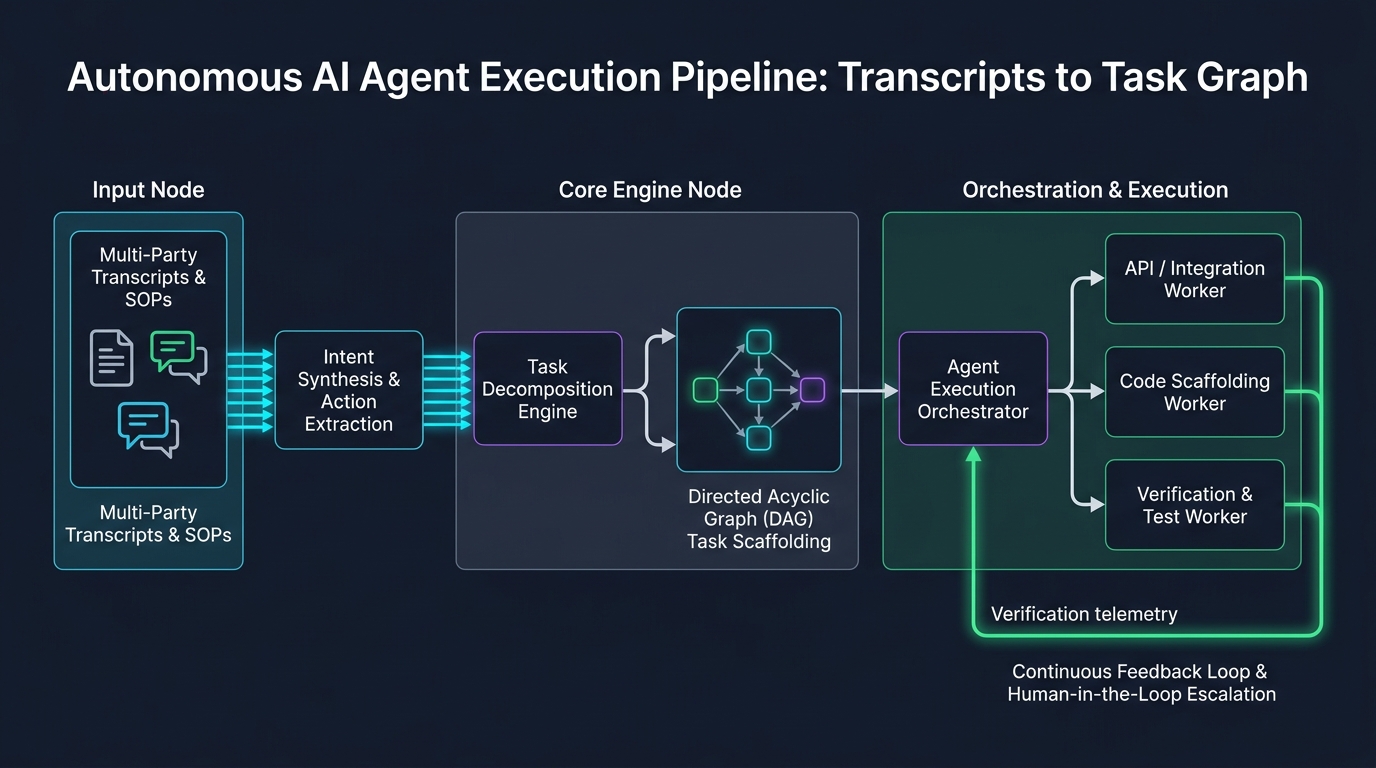
Instead of generating markdown bullets, AIDRAD parses transcripts through a 4-stage deterministic execution harness:
Stage 1: Intent Synthesis & Action Extraction
The raw transcript is parsed using Pydantic models that force the LLM to output discrete, verifiable actions with explicit acceptance criteria and input/output contracts.
Stage 2: Directed Acyclic Graph (DAG) Task Scaffolding
Actions cannot be executed in parallel haphazardly. If an agent builds an API client before the database migration schema is finalized, the code will fail. The orchestrator analyzes semantic prerequisites and constructs a dependency graph.
Stage 3: Specialized Agent Worker Dispatch
Rather than relying on a single monolithic prompt, tasks are distributed to narrow, tool-equipped worker agents:
- Schema Worker: Generates SQL DDL, Alembic migrations, and Pydantic models.
- API Worker: Scaffolds FastAPI / Express endpoints and OpenAPI specs.
- Validation Worker: Generates unit tests, mock fixtures, and property-based tests.
Stage 4: Verification & Human-in-the-Loop Gate
The code is built in an isolated sandbox. Only after automated unit tests pass and static analysis cleans the AST is a pull request and interactive live preview generated for stakeholder review.
3. Implementation: Building the Autonomous Graph Orchestrator
Below is a production-grade Python implementation using NetworkX and structured typing that translates extracted action items into an executable topological execution pipeline:
import json
from typing import List, Dict, Optional
from pydantic import BaseModel, Field
import networkx as nx

class TaskNode(BaseModel):
    task_id: str
    title: str
    role: str # e.g. "schema_engineer", "api_developer", "qa_engineer"
    prompt_brief: str
    dependencies: List[str] = Field(default_factory=list)
    verification_command: str

class ExecutionDAG:
    def __init__(self, tasks: List[TaskNode]):
        self.graph = nx.DiGraph()
        self.tasks: Dict[str, TaskNode] = {}
        for t in tasks:
            self.tasks[t.task_id] = t
            self.graph.add_node(t.task_id, task=t)
            for dep in t.dependencies:
                self.graph.add_edge(dep, t.task_id)

    def validate_executable(self):
        if not nx.is_directed_acyclic_graph(self.graph):
            cycle = list(nx.simple_cycles(self.graph))
            raise ValueError(f"Cyclic dependency detected in meeting action items: {cycle}")
        return True

    def get_execution_order(self) -> List[TaskNode]:
        self.validate_executable()
        order = list(nx.topological_sort(self.graph))
        return [self.tasks[tid] for tid in order]

# Example compiled from a 45-minute architectural sync:
sample_tasks = [
    TaskNode(
        task_id="TASK_01_DB",
        title="PostgreSQL Schema Migration for Tenant Invoices",
        role="schema_engineer",
        prompt_brief="Generate Alembic migration adding tenant_invoices table with UUIDv7 primary keys and index on tenant_id.",
        dependencies=[],
        verification_command="alembic upgrade head"
    ),
    TaskNode(
        task_id="TASK_02_API",
        title="FastAPI Route for Tenant Invoicing",
        role="api_developer",
        prompt_brief="Scaffold /api/v1/invoices CRUD endpoints with Pydantic v2 validation.",
        dependencies=["TASK_01_DB"],
        verification_command="pytest tests/test_invoice_endpoints.py"
    ),
    TaskNode(
        task_id="TASK_03_TEST",
        title="Integration & Rate-Limit Test Suite",
        role="qa_engineer",
        prompt_brief="Write pytest-asyncio integration tests validating 100 req/min rate limit per tenant.",
        dependencies=["TASK_02_API"],
        verification_command="pytest tests/integration/ -v"
    )
]

dag = ExecutionDAG(sample_tasks)
for step, task in enumerate(dag.get_execution_order(), 1):
    print(f"Step {step}: [{task.role.upper()}] -> {task.title} (Verified via: {task.verification_command})")
4. Guardrails: Keeping Autonomous Execution Grounded
Allowing AI agents to write code based on human conversation sounds dangerous unless bounded by strict architectural guardrails:
- Read-Only Production Boundaries: Agents only possess git write credentials to freshly branched feature workspaces (e.g.
agent/feature-intent-402). Never tomain. - Deterministic Verification Harness: No agent task is marked complete because the LLM says “I finished.” Completion is verified strictly by exit code 0 from
pytest,ruff, ortsc --noEmit. - Budget & Token Circuit Breakers: Every subtask is allocated a max tool-call quota (e.g. 15 iterations) and token ceiling to prevent recursive prompt loops when compilation errors arise.
Executive Takeaways
- Stop Paying for Passive Summaries: Meeting notes that do not trigger automated actions are organizational waste. Convert discussions into actionable intent graphs immediately.
- Topological Order Beats Parallel Chaos: Decomposing features into dependency-ordered DAGs ensures worker agents don’t build software on top of unverified assumptions.
- The 48-Hour Feedback Velocity: By transitioning from meeting notes to agentic execution, teams review functioning code and interactive UI previews the morning after an architectural sync.